The Story
In 2018, Tyndall Air Force Base sustained a direct hit from Hurricane Michael. Overall, 484 buildings were damaged and resulted in 792,450 cubic yards of debris, enough to fill Washington DC’s Capitol Rotunda 16.5 times. As the 325th Fighter Wing began to reconstitute, the Air Force Installation and Mission Support Center quickly realized the magnitude of effort required to rebuild the installation. In support of the wing commander, AFIMSC established the Program Management Office to oversee the repair, reshape and rebuild of Tyndall.
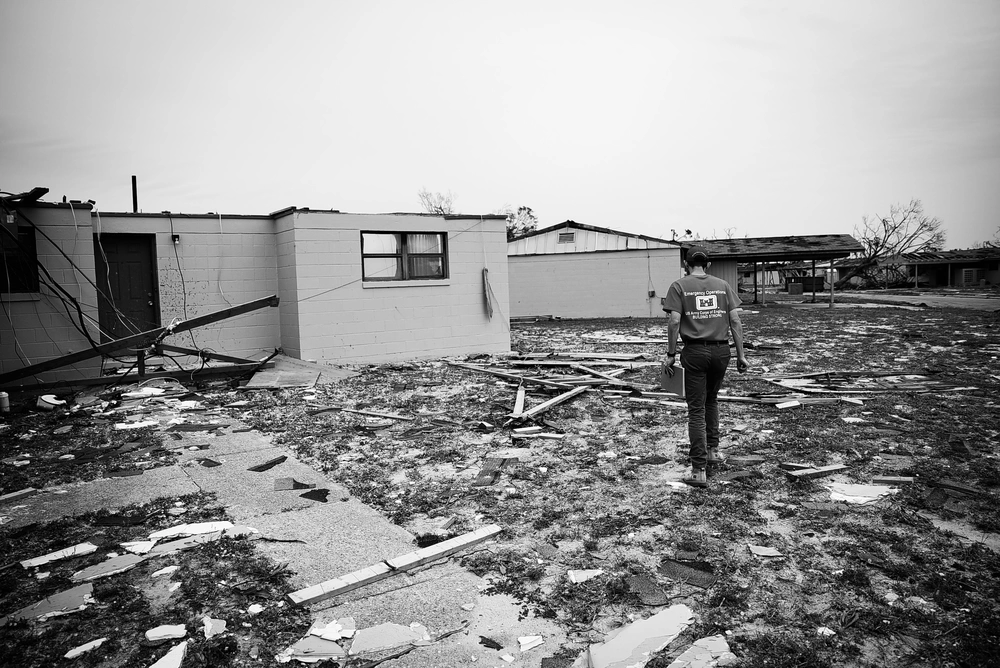 Following the destruction left from Hurricane Michael that strict the Florida panhandle, structural technicians and architects from the Army Corps of Engineers, Mobile District deployed to Tyndall Air Force Base to provide assistance and expertise in assess building damage throughout the base. (Photo by Dustin Gautney, U.S. Army Corps of Engineers)
In 2021, the PMO integrated with the Air Force Civil Engineer Center’s Facility Engineering Directorate to create the Natural Disaster Recovery Division, now the Special Programs Division, to continue the rebuild efforts at Tyndall and formalize support to additional bases affected by natural disasters including Offutt AFB, Nebraska, and Joint Base Langley-Eustis AFB, Virginia. The Tyndall-based SPD provides strategic construction management to assist Air Force installations to assess damage, quickly recover from disasters, and improve infrastructure resiliency. Tyndall and the SPD work hand-in-hand to reshape the base into a more lethal, ready and resilient base. Coined the “Installation of the Future,” the base will be the first of its kind in the Department of War, designed to meet the needs of current and future forces by incorporating resilient infrastructure, innovative designs and advanced technology to equip Airmen to execute the mission of today and tomorrow.
In August 2023, the first of many F-35A Lightning II aircraft arrived at Tyndall, the future home of three F-35 squadrons. As the base transitions into a combat-coded F-35A Lightning II combat wing, Tyndall remains operationally ready and continues to project unrivaled combat airpower for our nation and supports multiple tenant organizations throughout the rebuild process. Our Airmen remain ready for worldwide deployment in support of combat operations.
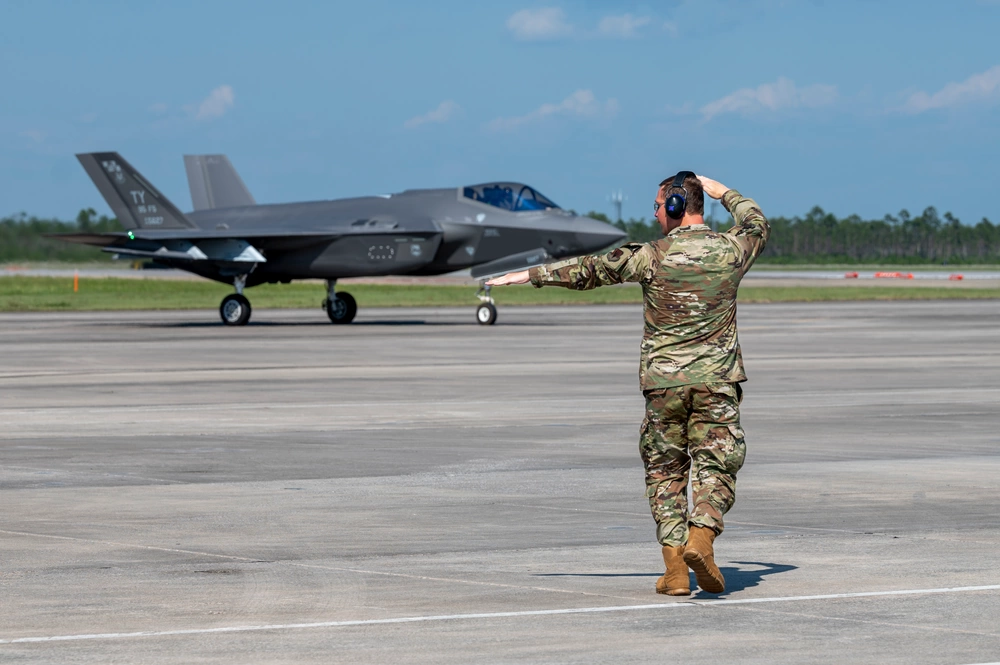 U.S. Air Force Senior Airman Nathan Copenhaver, 325th Fighter Generation Squadron crew chief, signals to the pilot of an F-35A Lightning II after its arrival at Tyndall Air Force Base, Florida, Aug. 1, 2023. The F-35 is the first visual representation of the 325th Fighter Wings mission change, bringing the 95th Fighter Squadron and aircraft back to the flight line of Tyndall. (U.S. Air Force photo by Senior Airman Tiffany Del Oso)
Tyndall’s multi-year rebuild effort includes 44 new military construction projects, providing 120 new facilities; and 260 facility sustainment, restoration, and modernization projects valued at $4.5 billion.
As of May 2026, the SPD has turned over several vital facilities to support Tyndall’s mission including the 325th Fighter Wing Headquarters, Emergency Operations Center and a F-35 flight training simulator. To support the morale of Airmen and their families, SPD has also turned over the new marina, swimming pool, chapel and two community commons buildings, equipped with a bowling alley and library. Construction is still ongoing and a number of projects are nearing completion.
Why Rebuild?
Our national leadership supports and encourages Tyndall’s transformation into the “Installation of the Future,” to include the construction of facilities designed to withstand the impacts of future hurricanes. The new facilities are optimized to reduce maintenance costs, increase safety/security and maximize functionality to enable efficient and effective mission execution. The IotF represents an evolution toward a more resilient, ready and lethal Air Force. Team Tyndall is creating a stronger, innovative and more efficient 21st century base to serve as the new standard for DOW installations.
Tyndall AFB is a critical asset for the nation’s defense strategy. It adjoins the Gulf Range Complex, comprised of 180,000 square miles of training airspace over the Gulf of America. The GRC is one of the few ranges in the U.S. capable of supporting large-scale air combat training. Direct access to this range is essential for fifth-generation fighter readiness, fourth-and fifth-generation fighter interoperability and live-fire testing and training.
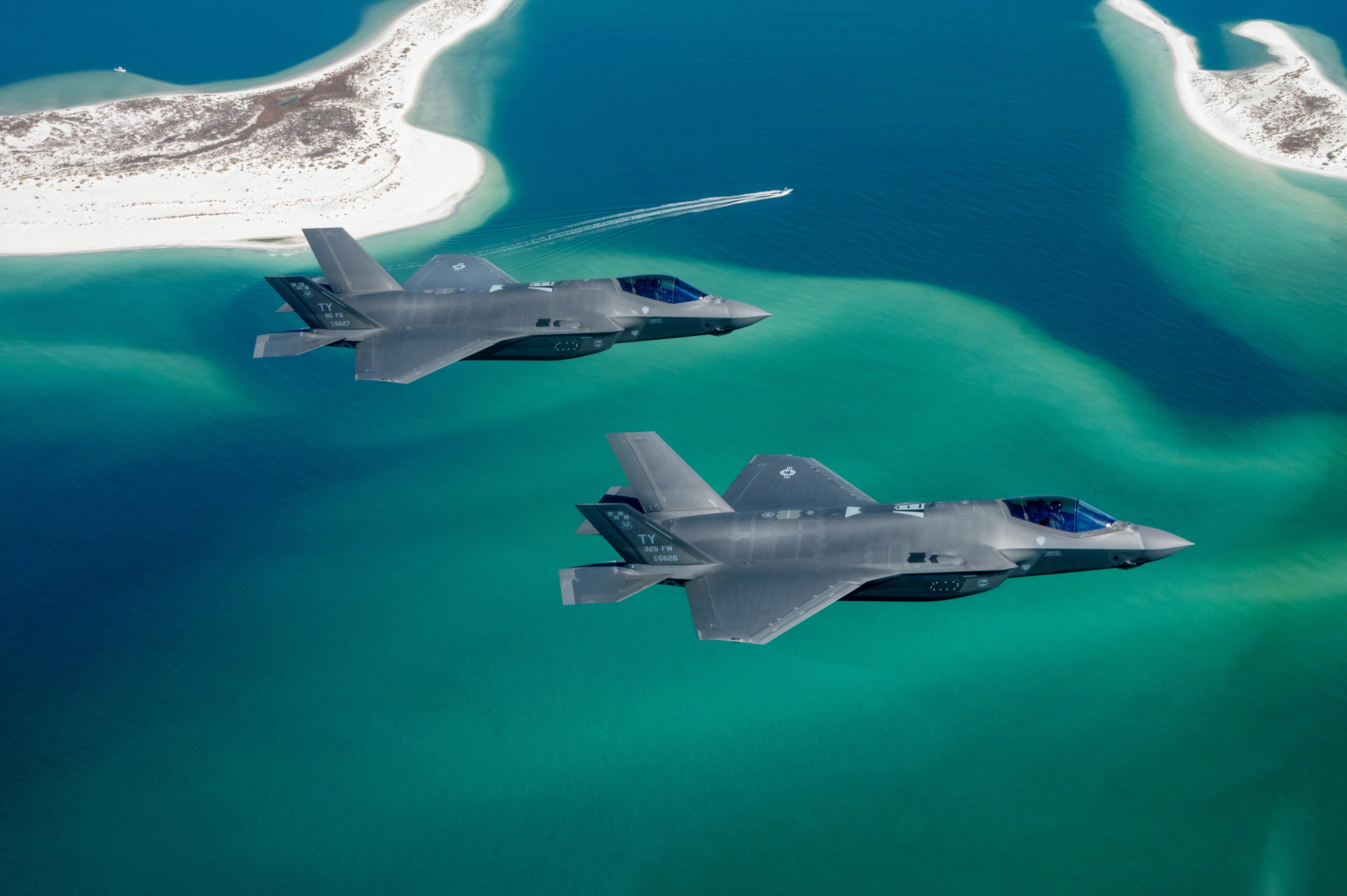 Flight operations over the Gulf Range Complex. (U.S. Air Force photo by Tech. Sgt. Betty R. Chevalier)